Dodo Visits COP 31 in Antalya: A Journey into Climate-Resilient Heritage
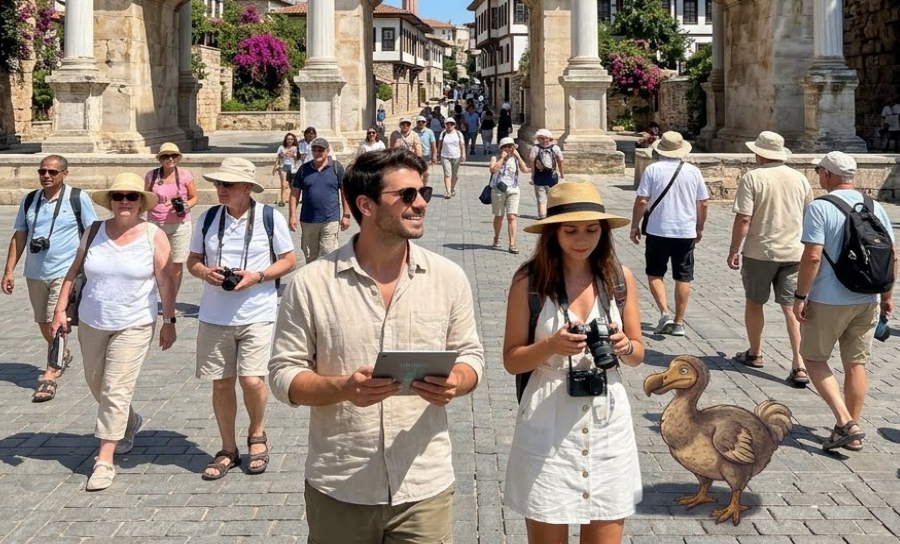
Antalya, Turkiye, November 11, 2026 / TRAVELINDEX / We are Ari & Leila. At twenty-four, our lives are measured in carbon equivalents, atmospheric parts per million & global heating lines. As climate scientists, we often find ourselves trapped in rooms full of terrifying numbers.
But data without human connection changes nothing. Today we are visiting Antalya in Turkiye.
Accompanying us is Dodo, a witty, fully interactive AI holographic projection modeled after the extinct species. Dodo acts as our environmental conscience and carbon-footprint tracker.
Our journey is guided by:
- The Earth Charter, spearheaded by the late Maurice Strong & Mikhael Gorbachev at the turn of the century. It treats environmental integrity, heritage protection, and peace as one single interconnected mission.
- Climate Friendly Travel (CFT) developed by SUNx Malta to deliver Climate Resilient, Sustainable & Nature Positive Tourism for a brighter future for our kids.
- CanadaStrong.travel, a coalition of Travel & Tourism SDG 17 partners promoting friendship in Peace Parks around the world. It includes IIPT, SUNx Malta, WSHA, PATA, Earth Charter Institute, POP, Ingle International, Tripian and WTN.
CHAPTER 1: Hadrian’s Gate
Standing where Antalya’s modern avenues meet the old quarter, Hadrian’s Gate is a breathtaking monument to 2nd-century Roman craftsmanship. Built in 130 AD to honor Emperor Hadrian, It features majestic Corinthian columns sculpted from smooth white marble. Tthousands of travelers pass beneath its carved cornices daily.
However, the Mediterranean climate crisis is creating unprecedented physical stress. Intense summer heatwaves are heavily amplified by the surrounding asphalt, creating an urban heat island effect that pushes midday temperatures past 45°C. This extreme heat triggers severe thermal expansion & nighttime contraction within the marble. This breaks down the stone, causing micro-fractures.
Leila pressed a digital thermal scanner against a weathered marble base, watching the screen glow a deep crimson. “The stone is literally baking from the inside out,” she warned Ari, pointing to a new hairline crack splitting the Roman masonry. “The marble can’t take sustained heatwaves. If atmospheric warming continues, it will create irreversible structural failure within decades.”
Dodo looked up at the carvings with a sharp gaze, squawking that even the strongest Roman masonry can’t fight a changing climate without help. Ari nodded, sketching out a sustainable engineering blueprint on his tablet. “With retractable, solar-powered shading sails at midday and sub-surface cooling loops, we can stabilize the stone’s temperature and protect it for another two thousand years.”
CHAPTER 2: Kaleici
The trio walked down into the winding alleys of Kaleiçi, Antalya’s historic quarter. This coastal neighborhood is famous for its narrow cobblestone streets, ancient sea walls, and rows of beautifully preserved Ottoman-era wooden mansions. Centuries ago, builders smartly designed these homes with overhanging upper floors to catch refreshing sea breezes and guide them through the tight residential corridors.
However, a growing Mediterranean heat dome is disrupting this delicate setting. Intense summer heatwaves and heavy, trapped humidity stifle natural coastal airflow through the narrow streets. Instead of cooling the town, the stagnant, damp air causes moisture to build up inside traditional plaster walls, rotting the original timber frames from the inside. At the same time, severe winter droughts bake the upper floors, drying out the ancient wooden beams until they become exceptionally brittle.
Leila paused by a weathered wooden facade, running her hand along a beam that felt surprisingly light. “The climate stress here hits from two sides,” she told Ari, checking her device. “Constant humidity attacks the inner frames, while blistering droughts strip away external moisture. We are looking at a historic neighborhood where beautiful wooden homes are turning into fragile tinderboxes, creating a massive fire risk if the local power grid overloads during peak summer tourism spikes.”
Dodo looked down the narrow alley with deep concern. “Slapping loud, energy-guzzling air conditioners onto these delicate wooden walls just dumps more heat into the streets and chokes the town further,” the Dodo squawked. Ari nodded, logging the details on his tablet to outline a cleaner solution. “We need to bring back traditional central courtyard fountains for natural evaporative cooling, and combine them with solar-powered attic vents to keep air moving safely without relying on the power grid.”
CHAPTER 3: Hidirilik Tower
At the edge of the old city walls, the cylindrical stone mass of Hıdırlık Tower stands proudly over Antalya’s historic harbor. Built by the Romans in the 2nd century, this imposing structure served for generations as both a defensive fortress and a vital maritime beacon. The tower now features a modern glass observation deck where tourists gather to watch the Mediterranean waves crash below.
Yet beneath this idyllic surface, a quiet environmental crisis is unfolding. Thermal expansion is pushing sea levels higher across the Gulf of Antalya, driving aggressive hydraulic wave pressures straight against the base of the porous cliffside. During fierce winter storms, heavy waves slam repeatedly into the rock, forcing seawater deep into natural fault lines.
Leila pointed her structural radar device toward the water table below. “The marine baseline shifts are accelerating the decay of these natural stone walls,” she told Ari, watching the telemetry ripple on her screen. “The rising tides are eroding the limestone from below, creating unseen hollow spaces beneath our feet. We can no longer rely on traditional defenses; if we continue to allow heavy storm surges to punch directly into this soft cliffside, the structural platform supporting the tower faces potential long-term collapse.”
Dodo peered over the edge of the cliff with a sharp, analytical gaze. “Pouring massive concrete retaining walls to block the water will only destroy the delicate intertidal ecosystem and poison local marine life,” the Dodo squawked with warning emphasis. Ari nodded, typing rapidly to construct a cleaner, nature-based alternative on his tablet. “To honor the Earth Charter, we propose the Hıdırlık Eco-Barrier Project. By placing offshore, submerged eco-reefs made from recycled ceramic waste and native seagrass beds (Posidonia oceanica), we can break the physical energy of the incoming storm surges while creating a vital blue carbon sink.”
CHAPTER 4: Perge Ancient City
A short journey via the zero-emission electric tramway brought the team east to Perge Ancient City, an architectural marvel with a vast stadium, massive thermal baths, and a monumental colonnaded street. Built by successive Greek and Roman civilizations, it is famed for its advanced urban water network, which flows from a huge fountain down a magnificent central stone channel to cool the bustling town. Today, the site is one of the Mediterranean’s most significant archaeological attractions.
However, the surrounding Aksu river basin is experiencing severe, drought cycles. The intense midday sun completely bakes these unshaded ruins, driving thermal spalling of the ancient marble friezes and limestone blocks. Without any natural canopy or active cooling vectors, the sun-exposed columns absorb extreme thermal energy during heatwaves, causing their outer layers to flake, crack, and turn to dust.
Leila knelt beside a fractured column along the main avenue, adjusting her environmental sensor. “The temperature across these stones is hitting nearly 48°C,” she said, displaying the live data on her screen. “The intense radiation combined with severe water scarcity is drying out the ancient mortar and stone fibers. Without a way to combat this extreme heat, the delicate reliefs and inscriptions carved into these monuments will be completely erased within our lifetime.”
Dodo ruffled his feathers as he hopped over the dry stone bed of the central Roman canal. “A water city without any water is just an oven for history,”. Ari nodded, logging the watershed data onto his tablet. “We propose an Urban Watershed Initiative. By filtering regional agricultural runoff through native reed beds, we can re-route clean, non-potable water back into Perge’s ancient central channel, dropping local air temperatures by up to 4°C to stop thermal stress.” Dodo nodded enthusiastically.
CHAPTER 5: Lower Duden Waterfalls
The roaring cascade of the Lower Düden Waterfalls served as the dramatic backdrop for the latest stop on Ari, Leila, and the SUNx Dodo’s tour through Antalya. Plunging over forty meters directly from the rocky city cliffs into the surging Mediterranean Sea, the falls stand as a breathtaking reminder of nature’s raw beauty. Dodo perched enthusiastically on the viewing platform, his wide eyes reflecting the scale of the freshwater rushing to meet the sea.
Yet beneath the mesmerizing roar lies a quieter, more urgent story about the delicate balance of Antalya’s water systems. Local guides explained to Ari and Leila how the subterranean rivers feeding the Düden system are facing unprecedented pressures. Rising global temperatures have triggered prolonged periods of drought across the Anatolian plateau, drastically altering seasonal water flows. At the same time, shifting rainfall patterns mean that when rain does arrive, it often falls in intense, destructive bursts threatening the stability of the limestone cliffs.
This directly impacts the marine and coastal habitats below. As the volume and temperature of the freshwater influx fluctuate unnaturally, the localized salinity of the surrounding sea water changes, disrupting native marine life. Leila noted the threat of invasive species into the warming waters while Ari recorded data on how reduced river flow diminishes the natural transport of nutrients to coastal fish populations.
In response to these challenges, the team highlighted the community-led adaptation strategies transforming Antalya into a climate-resilient destination. Local environmental authorities have implemented advanced water-management networks to optimize agricultural irrigation upstream, ensuring that precious river water is not wasted before it reaches the coast. By promoting low-impact eco-tourism, such as carbon-neutral electric boat tours that view the falls from a safe distance, the region is actively reducing the ecological footprint of its visitors.
CHAPTER 6: The Mountain theatre of Termossos
High amidst the jagged peaks of the Taurus Mountains, the unexcavated ruins of Termessos offered the latest, frontier for Ari, Leila, and Dodo. Perched over 1,000 meters above sea level within a rugged national park, the ancient city retains an aura of wild, untouched mystery. For the young explorers, climbing the steep, pine-scented trails felt like stepping back into a forgotten world. Dodo stood wide-eyed on the precipice, marveling at how the stone tiers clung dramatically to the mountain slopes.
Yet, this high-altitude sanctuary is facing an invisible ecological siege fueled by rising alpine temperatures. Warmer winters have allowed invasive pests to climb higher into the mountain zones, decimating the native coniferous forests. Without the strong root networks of these ancient trees, the steep slopes are left incredibly vulnerable.
The true catastrophe strikes when these weakened ecosystems meet sudden and intense winter monsoons. When these torrential downpours hit the heat-baked, unanchored mountain soil, the result is immediate and destructive flash flooding. Tremendous volumes of water and mud rush down the slopes. A landslide powerful enough to dislodge the intact stone tiers of the magnificent theater.
A major reforestation initiative is underway, focusing on planting pest-resistant native flora to rapidly stabilize the upper slopes and re-anchor the fragile soil structure. Additionally, engineers are mapping out eco-friendly, low-impact drainage channels to safely divert flash-flood waters away from the site.


